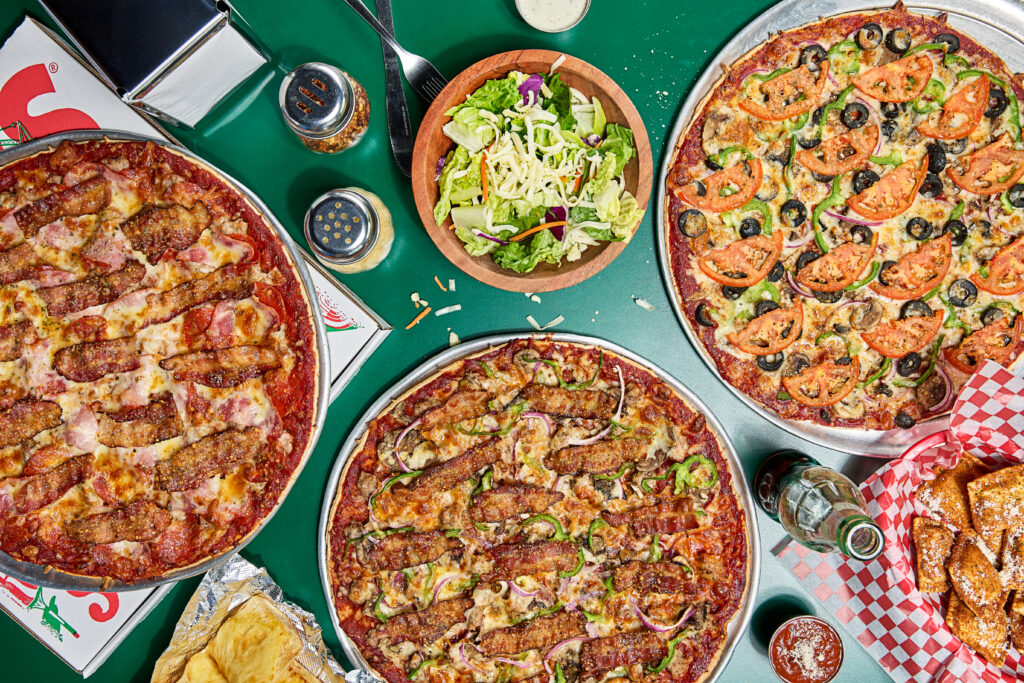
For sixty years, a Friday-night craving in St. Louis has ended the same way: a thin, square-cut Imo’s pie loaded edge-to-edge with Provel® cheese. With that baked-in regional loyalty, Imo’s Pizza has attracted several entrepreneurs who want to help deliver that authentic St. Louis flavor to their own customers in cities across the midwest. But in a crowded market with dozens of competitors, some might have doubts about the profitability of owning a pizza franchise.
Are pizza franchises profitable enough to be worth a serious commitment? They can be, though the outcome rests on your revenue and how tightly you manage costs. This guide breaks down what a pizza franchise really earns and how Imo’s Pizza’s unique differentiators can give motivated owners the edge.
Key Takeaways
- Pizza franchises can be profitable, but your take-home depends on how well you control costs and run the location.
- Industry estimates put typical franchise pizza-shop net margins near 10% to 20%, on average revenue around $766,000 per location (PMQ Pizza Power Report).
- Food and labor are the two biggest levers. At Imo’s Pizza, each runs about 35% of Net Royalty Sales (Imo’s 2026 FDD).
- Imo’s keeps its royalty at 4% of weekly Net Sales, so more of each dollar stays with the owner (Imo’s 2026 FDD).
- Profit is never guaranteed. In 2025, 42% of restaurant operators said their business was not profitable (National Restaurant Association).
So, Are Pizza Franchises Profitable?
A well-run pizza franchise can be profitable, especially with a well-run shop that relies on proven systems. Profit for a pizza franchise comes from the revenue a location earns minus the cost of running it. In a crowded marketplace and among rising prices for ingredients and labor, those costs are higher than ever.
That said, demand is real and large. Pizza Today reports that the U.S. pizza market reached a projected $49.5 billion in 2024. That came from more than 75,000 pizzeria businesses, including local shops and franchise favorites alike.
But when it comes to pizza profitability, what you actually keep depends on the numbers.
How Much Revenue Do Pizza Franchises Generate?
Revenue is the total sales a location brings in before any costs are paid. It’s not profit. But it’s the first number most prospective owners want to see, and it’s a useful gut check.
The PMQ Pizza Power Report 2026 gives a fresh benchmark. Its Datassential rankings put 2024 sales for the five largest U.S. pizza chains at roughly $24.5 billion across about 22,200 locations. That’s about $1.1 million per store.
The spread is wide, though. Divide each brand’s sales by its unit count and Pizza Hut lands near $812,000 per store, Little Caesars near $1.16 million, and Domino’s near $1.35 million. The same category shows very different results. Brand, market, and how well the store is run all matter.
Independents are a useful contrast. According to Slice data in the same report, even the top quartile of independent pizzerias averaged $658,548 in annual sales.
Imo’s Pizza offers a concrete, current example. The Imo’s 2026 Franchise Disclosure Document (FDD) reports average Net Royalty Sales of $1,309,139 and a median of $1,243,123 across 91 traditional stores in 2025. Net Royalty Sales is the FDD’s defined sales term, not a profit figure, and results vary by owner.
What Profit Margins Can A Pizza Franchise Owner Expect?
Profit margin is the share of revenue you keep after paying every cost. Franchise pizza shops tend to run higher margins than independents, which is part of the appeal.
According to Toast’s analysis of franchise pizzeria profit margins, franchise shops see estimated net margins near 10% to 20%. Independent pizzerias run lower, near 5% to 10%. Whatever the range, your margin is simply what remains after every cost is paid.
Two costs decide most of the outcome: food and labor. The Imo’s 2026 FDD breaks this down for 33 stores in 2025. Average food and paper cost ran 34.79% of Net Royalty Sales, and average labor cost also ran 34.79%.
The Costs That Shape Your Take-Home Pay
Your profit is whatever remains after the bills are paid. The main cost categories include startup investment, ongoing fees, rent, food, and labor. A royalty is the ongoing fee you pay the franchisor, usually a percentage of sales, in exchange for the brand and its systems.
Startup investment is the first hurdle. The Imo’s 2026 FDD lists a total initial investment of $543,804 to $959,336. The initial franchise fee is $40,000 for a first location and $30,000 for an added one.
Ongoing fees also hit every week. Imo’s keeps its royalty at 4% of weekly Net Sales. This sits below Papa John’s royalty rate of 5% of Net Sales; as a result, more of each dollar stays with the owner.
Challenges To Consider Before You Invest
Strong sales are great, but they can’t guarantee profit. The National Restaurant Association’s look at restaurant profitability pressures found that 42% of operators said their restaurant was not profitable in 2025.
Rising food and labor costs are the biggest culprit. Add local competition and the daily work of keeping good staff, and the math gets tight fast.
If you’re an entrepreneur who wants to bet big on pizza, approach with clear eyes. The owners who plan for these operating costs are often the ones who protect their profit over the long run.
What Gives Some Pizza Franchises A Profit Edge
A few factors push a pizza franchise toward the profitable end. Brand loyalty brings back repeat customers who already know what they want, a fact exemplified in the Imo’s Pizza brand story. Imo’s built that following over six decades, with 95+ locations spread across Missouri and into Illinois and Kansas.
Every Imo’s ingredient, including its signature Provel® cheese, flows through the affiliated Imo’s Foods, Inc. That is a moat competitors can’t easily copy.
Flexible formats keep overhead in check. Owners can run a lean carryout store, a delivery-focused kitchen, a full dine-in restaurant, or a hybrid of these.
Strong franchise training and support then protects margins from day one. The wider market backdrop helps too. The International Franchise Association projects franchise output to rise from $907.3 billion to $921.4 billion in 2026, per its franchising economic outlook.
Frequently Asked Questions
How much profit does a pizza franchise owner make?
It varies widely, but a busy, well-run franchise can leave an owner a solid income once every cost is covered.
Is a pizza franchise a good investment?
It can be a strong investment for an owner with enough capital and a solid plan to manage costs, backed by a known brand.
How is a pizza franchise different from an independent pizzeria?
A franchise gives you an established brand, proven recipes, a ready supply chain, and hands-on support, which can lower the risk of opening cold.
How long does it take a pizza franchise to become profitable?
The timeline depends on where you open and how fast the store ramps up, so no single number fits every owner.
What Pizza Franchise Profitability Comes Down To
So, are pizza franchises profitable? Yes, when the owner respects the numbers behind the pizza. Revenue sets the ceiling, and disciplined cost control sets the take-home.
At Imo’s Pizza, we pair six decades of hometown loyalty with a proprietary supply chain and hands-on owner support.
Ready to bring The Square Beyond Compare® to your community? Explore the Imo’s Pizza franchise opportunity and grab our FREE eBook.